
Jacksonville Busted Arrest Records
Jacksonville runs its records through one shop. The Jacksonville Sheriff's Office wears three hats at once: city police, county sheriff, and county corrections. No separate city police department exists. No city jail database either. A local arrest ends at the John E. Goode Pretrial Detention Facility, where JSO handles intake, builds the booking record, and takes the identification photo. That shared ownership means one official inmate system holds most of what people want: Jacksonville busted mugshots, custody status, charges logged at booking, bond amounts, and release details.
Jurisdiction adds a wrinkle, though. The beach cities run their own police, and so do the University of North Florida and Jacksonville International Airport. A booking record's arresting-agency field sorts out that tangle. Size is the other challenge. Jacksonville held an estimated 1,017,689 residents on July 1, 2025, up from 949,611 in the 2020 Census. Name searches alone will bite you in a city that big. Match the jail number, JSO ID, booking date, age or birth date, and arresting agency before trusting any result.
Jacksonville Busted Mugshot Sources
Pick the source that answers your actual question. JSO's official search spans both current and historical records, covering people in custody and those already released. Need only the locked-up population? Apply the current-custody filter. The Recent Bookings and Release Log functions tackle time-based questions instead, and the Duval Clerk's CORE system tracks the court case itself. News outlets and private sites sit at the end of that chain. They copy, select, and reshuffle records that someone else created.
| Channel | Photo? | Status | Best use |
|---|---|---|---|
| JSO Inmate Information Search | Can display one | Official | Current or released Jacksonville bookings by name, jail number, or JSO ID |
| JSO Recent Bookings and Release Log | Record-dependent | Official | Recent intake or exit from local custody after portal verification |
| Duval CORE | Not its purpose | Official | Filed charges, docket events, orders, and disposition |
| Local news outlets | Sometimes | Editorial | Selected incidents, agency statements, reports, and later court reporting |
| Recently Booked, Arrests.org, and Arrest Florida | Varies | Unofficial | Secondary discovery only; confirm all details through JSO and CORE |
One caution about photos. JSO says its portal can display mugshots, but the agency promises no picture for every record. Processing status, confidentiality rules, policy, or the interface itself can all hide an image. Expect a verification screen on a first visit, and don't read a failed search as proof that nothing exists. Private sites deserve even more doubt. Their pages run stale, incomplete, duplicated, or flat wrong. Mugshots.com is weakest of all here, since its supposed Duval section lists Jackson County locations. Busted Newspaper and Mugshots.zone offer no verified Duval edition to fall back on.
Note: A release entry means the person left local custody; it does not say that prosecutors dropped the case.
Find Jacksonville Busted Bookings
Start with the booking source. Then work toward the court record, and let custody status guide the path. Someone booked minutes ago may not show up yet. Intake and identity checks take time. A current inmate calls for the active-custody filter. A released person can still surface in the broader historical search. State prison is different territory entirely. After a state sentence, the person belongs in the Florida Department of Corrections system, not the county's active roster.
- Open the official JSO inmate portal and complete its verification step. Search by jail number or JSO ID when known; otherwise use first and last name.
- Select “Search Only Inmates in Jail” only when the question is present county custody. Leave it off for a released or historical Jacksonville booking.
- Compare the booking date, jail number, JSO ID, age or birth information, and arresting agency. Do not identify someone from a picture alone.
- Open the detail and read charge status, bond, holds, court information, custody or release status, and the mugshot when one is available.
- Search Duval CORE for the case. The docket, later filings, orders, and disposition provide context that the intake snapshot cannot.
- If the official search stays blank, wait for intake to finish, broaden the active-only setting, then ask JSO for the precise booking record and original photo.
The Duval County booking and roster overview walks through the countywide paths in greater depth. It covers records after local release and the move to state custody. One photo trap is worth knowing. FDC may show a state offender photo issued after a state sentence, and that image may not match the Jacksonville intake photo. People sentenced at the county level often move within JSO instead. They land at Montgomery Correctional Center or the Community Transition Center.
Jacksonville Booking Intake Timing
Booking takes time. JSO lays out several steps before a person is ready for release or a visit: staff inventory property, finish booking paperwork, run a medical screening, verify identity, and assign a cell. The identification photograph belongs to that intake record. But JSO commits to no fixed online posting schedule. So a person can sit inside the process while a public name search returns nothing at all.
That limit matters most on your first search. Wait, then retry with the strongest identifier you have. Double-check spelling, and lift the active-in-jail restriction when a quick release seems possible. Still stumped about local custody? Call jail information at 904-630-5760. Keep in mind that a missing online result can stem from release, confidentiality, sealing, a portal limit, or plain error, so silence alone never proves that no Jacksonville arrest happened.
- Booking
- The intake process that records identity, property, charges, custody details, and an identification image.
- Bond
- A court-set condition for release, not a judgment of guilt.
- Disposition
- The later result of a court case, such as dismissal, plea, trial result, or another final action.
Jacksonville Arrest Record Requests
What you see online is only part of the file. A written request can pull more. It gets you the full arrest report plus the original booking photograph. Give JSO as much as you can: full name, date of birth, arrest date, jail number, and JSO ID if you have it. The more specific you are, the faster the records unit can find the item and apply whatever redactions Florida law requires. No fixed fee or turnaround time is published. Wait for the office to respond rather than assuming either one.
There are several ways in. Use the JSO public-records route, call, mail it in, or visit a counter. The records phone line runs weekdays from 8 a.m. to 4:30 p.m. The Forsyth Street lobby keeps longer daily hours, but it is an office, not a photo gallery. Ask for documents, not commentary. JSO does not write new reports on request.
Jacksonville Sheriff's Office Public Records Unit
Police Memorial Building
501 E. Bay Street
Jacksonville, FL 32202
Records: 904-630-2209
Non-emergency: 904-630-0500
General information: 904-630-7600
Florida's public-records law allows exemptions, so expect some material to be blacked out. An arrest report often holds far more than the roster line you saw online: the officers involved, where and when the arrest happened, booking details, and the probable-cause account. Ask for what you need and nothing more. Want a case outcome or a court filing? That belongs to the Duval Clerk, not to JSO, and the arrest report will not turn into a full case history no matter how you ask.
Jacksonville Calls Are Not Arrests
There is no separate city-police blotter in Jacksonville. JSO is the city agency, so one office handles it all. The Completed Dispatched Calls for Service interface still gives a useful window on recent police activity. It refreshes every few minutes on its own. Each entry can show an incident number, the dispatch date and time, a block address, the signal, and a short description.
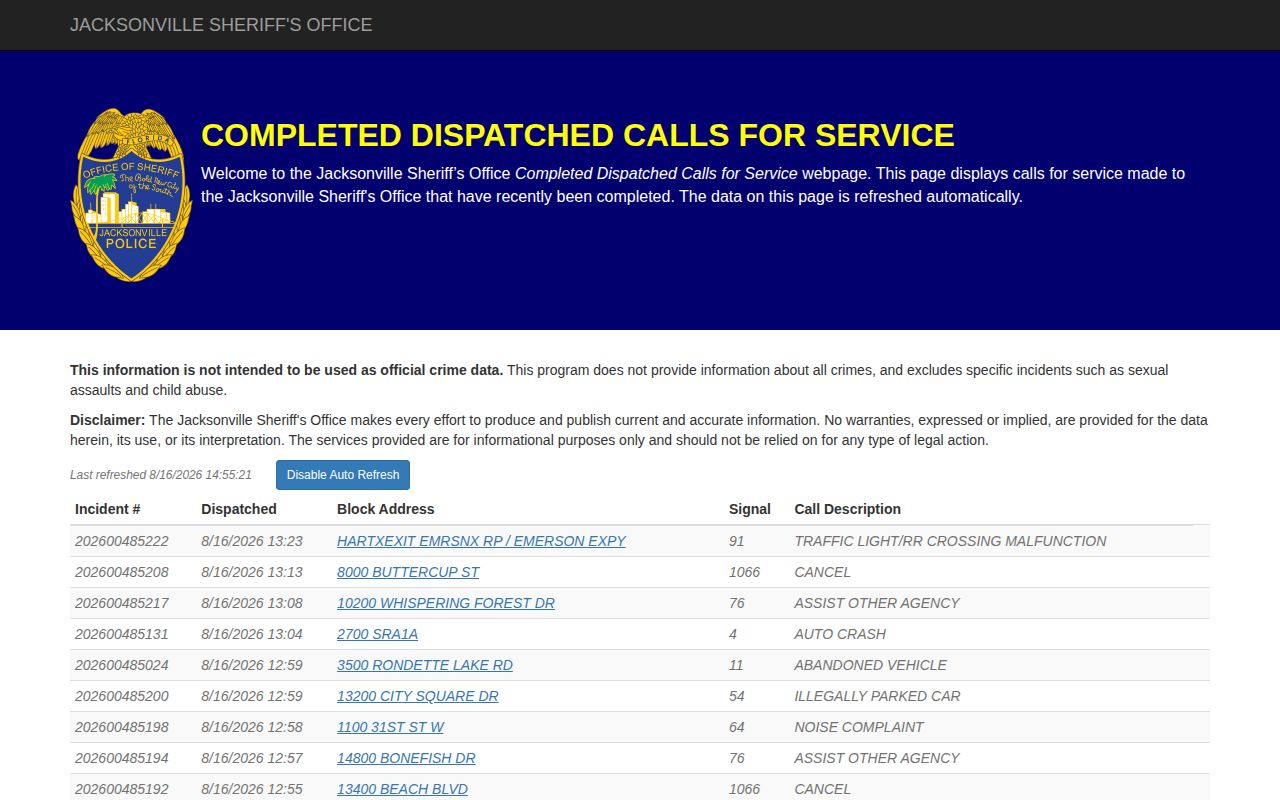
That tool covers calls, not bookings. JSO itself warns that the completed-calls list leaves out certain sensitive events and is not official crime data. A dispatch entry does not mean anyone was arrested. It will never include a booking photo. For a Jacksonville busted record, use the inmate portal. Request the specific report if you need it, and turn to CORE for anything court-related.
Note: Treat a call entry as activity at a place and time, never as proof that a named person was arrested.
Jacksonville Busted News Coverage
Four big outlets cover selected Jacksonville arrests on a regular basis: News4JAX, Action News Jax, First Coast News, and the Florida Times-Union. Their stories pull from JSO statements, arrest reports, court files, body-camera footage, interviews, and other images. News value drives what runs. None of them offers a complete booking feed, and the first charge description in a story can change once prosecutors file the actual case. News4JAX keeps a frequently refreshed crime topic page, while Action News Jax and First Coast News post daily and breaking local reports. The Times-Union's crime coverage may sit behind a paywall. The Jacksonville Daily Record leans toward courts, business, and legal affairs rather than any mugshot blotter. For a closer look at these editorial paths, see Mugshots in the News.
Private sites add another layer over Duval. Recently Booked shows a rolling set pulled from public sheriff records, though its statement about Duval photos clashes with JSO's own wording about its portal. Arrest Florida carries a Duval filter with JSO entries. Treat all of these as discovery aids. Verify names and charges against official JSO and Clerk records, especially when a copied page lingers online after a local case has moved on.
Jacksonville Booking Outcomes
A Jacksonville booking opens a paper trail rather than closing it. The charge listed at intake is what officers entered that day. It can change later. After a bond-out or a judge-ordered release, the next stop is usually arraignment, where the filed charges are read aloud, and those may differ from the booking description. From there, CORE tracks the docket events, orders, and the disposition, which is simply how the case ends.
Each source answers one question. The active roster tells you who is in local custody right now. The wider JSO search can surface a released or older local booking. The Release Log marks an exit from county jail, nothing more. FDC covers people who move into state corrections after sentencing. A federal locator handles federal custody but shows no Jacksonville mugshot. Stack these together carelessly and you will end up with a status nobody actually has.
Same-name results demand patience. Match identifiers and dates before you trust a hit, and read the docket through its latest event. Access varies by case type, document, and viewer role, so a hidden filing may take a focused Clerk request. The safe read is narrow. The booking record shows one event. The court file tells you how things turned out.